Wednesday, 3 May 2023

Extend therapy Beyond the therapy room

Therapy should not be limited only to the therapy room, but should always extend in the world outside of the therapy center. The motor learning principle postulates that in order for the brain to learn anything,

  •           it requires many repetitions of the task.
  •          and the same task performed in various ways.

The required repetition and the variation necessitates that therapeutic tasks should be incorporated as a part of daily life and in the real world. For children, work is play. Every child deserves to have fun. At the same time, every child needs to learn many daily functions of life as a preparation for participating in the world. Hence play, fun, and function, all need to be included in therapy. When a task is learnt through play, it requires less repetitions to learn. Therefore, the point is to learn tasks through play at home and elsewhere in the external world. This is known as carryover of therapy in the world of physiotherapy and occupational therapy.

Tasks or activities will heavily depend on the age and capacity of the child. There are various activities that can be incorporated into the daily / weekly routine that would provide the necessary meaningful movement and sensory input. Additional benefits would be a sense of accomplishment, increased confidence, and self-esteem.


Do activities that are suitable for your child.

Ensure SAFETY and SUPERVISION to prevent

  •         mouthing or swallowing small objects
  •        prevent falls that can lead to serious accidents such as fracture or head injury.


Do remember to watch the YouTube videos on

https://www.youtube.com/watch?v=TfljcTYjfeo&t  So many therapeutic activities are possible in the form of play to enhance a child's sensory-motor capacities. These are not a replacement for therapy administered by a professional therapist. Based on Dr. Ushma's clinical activities and suggestions, they have been performed at home by parents who avail therapy for their child at Activ Kaarya.

https://www.youtube.com/watch?v=EyjHNmxGRoY&t=45s  A variety of material such as bubble wrap, brown paper, rice flour, can be used to have fun. Work on the smaller muscles of the hand by using the pipe-cleaner and single-hole puncher.

https://www.youtube.com/watch?v=dy1Iro0GmCI&t=73s  Simple rubber band activity for young children.

https://www.youtube.com/watch?v=Tbr0da596-w  this is a video on making playdough at home. You can make it in larger quantity, it is less crumbly, and children can roll, poke, squeeze, and press – great muscle work for hands and fingers.  


Functional activities that provide therapeutic value and instill a sense of responsibility

Use the Indian ingenuity, also known as ‘jugaad’ to find items in your own home so that your child is occupied in meaningful tasks and is receiving sensory input at the same time.

1.     My favorite task for children is removing wet clothes from the washing machine. Wet clothes are heavy, sometimes tangled, and need to be pulled with two hands. There you are working on bilateral coordination, tactile, and proprioception. Not to mention balancing task whether the child is standing on the floor or standing on the stool and bending over a top load machine. Once all the wet clothes are removed and placed in a bucket, pushing the bucket to the dryer stand is another proprioceptive task that also provides visual-spatial awareness.  

2.      Push the bucket containing wet clothes towards the balcony or drying rack.

3.      Dry clothes on a rack.

4.      Park all your groceries at the main door of the home. Let your child carry each item from the main door to the kitchen. It could be small bags of grains, fruit, vegetables.

5.     Teach them to drag the 3 kg or 5 kg atta bag while walking backwards.

6.    Have your child play in plant soil, dig, and pick up soil with hands. Working with soil / gardening serves as an anti-depressant. Micro-organisms found in plant soil, compost, and leaf mold can help release serotonin which is a feel-good neurotransmitter.

7.      Use a spray bottle filled with water to squirt on plants and bathroom walls.

8.      Scrub bathroom walls using scrubbers – rotating in various forms such as plastic, coir, utensil green scrubber.

9.      Wipe tables after a meal using a small wet towel.

10.  Wring / squeeze towels with both hands.

11.  Pour water on self while using a mug during bath time.

12.  Give them a coir loofa to scrub themselves during bath time.

13.  Give 3-4 size containers such as small medicine cup, plastic glass, squeeze bottle to pour water from one container to another.

14.  Do not hold the banana for the child. Have them hold a banana with 1 hand, peel it with another hand, eat, and then throw the peel into the dustbin. Speak to them about the different actions and you end up teaching them a whole task.

15.  Teach them peeling oranges too.

16.  Use a small pestle-mortar to pound peanuts.

17.  Churn buttermilk using a wooden tool.

18.  Pour half kg to 1 kg of rice-dal packets into a jar.

19.  Place a beach ball into a pillow cover, tie it up into a potli, and suspend it from the ceiling.  Tap the ball back and forth using 2 hands.

20.  Similarly, place a tennis ball in a sock, tie it up, suspend it from the ceiling. Let your child hit it with a plastic bat.


Pre-writing Activities

1.     Scoop grains like rice, dal, and beans using 2 hands, small cups, and pour the same in another container.

2.      Tear paper and crush pieces of paper into a ball prior to throwing in the garbage.

3.      Finger painting and Vegetable printing.

4.      Sort vegetables such as potatoes, onions, lemons, tomatoes etc either using tongs or hands.

5.      Use at least 2 different sized tongs to pick up objects. You can buy them at a local store.

6.      Peel boiled potatoes, mash them if needed.

7.      Let your child pick up large pieces of watermelon with fingers. Let them use fingers to pick up pieces of fruit, salad vegetables, dosa, paratha.

8.      If your child can handle a fork, let them poke into pieces of fruit with a fork.

9.      Cut boiled or firmly boiled vegetables such as carrot, pumpkin, sweet potato----use a plastic knife.

10.  Use plastic tools such as knife and spatula to manipulate/ cut/ lift playdough.

11.  Hide small treasures such as coins, beads, bottle caps etc. into playdough or therapy putty and let your child find it.

12.  Use an eye-dropper to drip colored water.

13.  Pick up tooth-picks and insert them into a salt-pepper shaker. Make sure that the child is holding the shaker with 1 hand while using the other hand to insert toothpicks into the holes.

14.  Pull and fix rubber bands around a steel glass or cardboard cylinder.

15.  Fix clothespins on a chart paper.

16.  Have your child write large letters in shaving cream, flour, sand.

17.  Writing/drawing/painting on a vertical surface—stick a large chart paper on the wall a little above eye level. This helps stability of shoulder and wrist.

18.  Place a large chart paper on the floor and let the child color in crawling position.

19.  Write/ color on a slate, or blackboard, or driveway with chalk.

20.  Focus on drawing shapes such as circle, square, cross, diamond, etc. prior to writing letters.

21.  Trace a letter on your child’s back and have them identify it.


Cycling

Many parents purchase a bicycle with training wheels / side wheels, only to find that their child is having difficulty with peddling. Peddling and balancing when the bicycle moves is not as easy as we think.

At home, you can place old shoes under the side wheels. Now you have converted this into a static bicycle. Your child can sit on it and practice peddling, but the bicycle will not move.

At Activ Kaarya, we use the peddler to practice peddling. Please read the following blogpost.

https://sensoryintegrationbangalore.blogspot.com/2016/03/peddler-in-pediatric-therapy.html

Learning to cycle may take a few weeks or months. In some cases, children have learnt to ride a bicycle with side wheels within a few sessions.


Outdoor Activities

1.    Go to the park 4-5 times a week, sometimes to indoor play areas that offer so many opportunities for climbing, jumping, crawling, and balancing.


2.    Go for frequent walks with your child, have them carry a weighted backpack which is 10% of their body weight.


3.      While travelling, let your child pull the wheelie bag as and wherever possible.


4.   Take your child to the street market / desi market with you. (not supermarket).  Let them experience the colorful atmosphere of the market, look at the sarees hanging in the stores, the heaps of colorful fruit and vegetables, the smell of food being fried in small shops, and much more. Carry a bag or a bag pack to fill up and walk back home. 


5.      Push a heavy cart in the super market.


6.      Carrying weighted bags home from the market.


7.    Go for walking in natural enviroments. Bangalore is gifted with natural sites around the city – Nandi hills, LalBagh, Cubbon park, Banerghatta zoo, that offer walking and climbing. 


8.      A day can be spent on a farm where the child can play in mud, splash in water, and much more.


9.    Swimming can be learnt gradually. But first let the child just float in water wearing the safety gear. A parent can also get into the pool with the child.


10. If you are planning a vacation, go the beach. The beach offers a natural sensory environment – the different textures of the sand on various parts of the beach, the sound of the waves, making a sand castle that involves scooping, digging, pouring, and pressing.


https://www.youtube.com/watch?v=yZT5nfhnOjA home as well as open gym exercises can be done by children 5 years and older.

https://www.youtube.com/watch?v=X-u1W7cOCp8  simple activity with balls and cups to enhance reaction time, attention, cognition.

https://www.youtube.com/watch?v=n55pNvYiQw0 rubber band activity for children 5 -6 years and up, for finger strength. You can do them during travels also.

https://www.youtube.com/watch?v=nprmd3l8Nmc&t  to improve single-leg balancing, timing & sequencing to an auditory beat, figure-of-8 walking. Please watch and follow 16:00 onwards on this video.


Have Fun with your child! Include Play & Language in all the activities that you do. Connect with child. Give up the screen and be present with your child in the moment!


Saturday, 26 March 2022

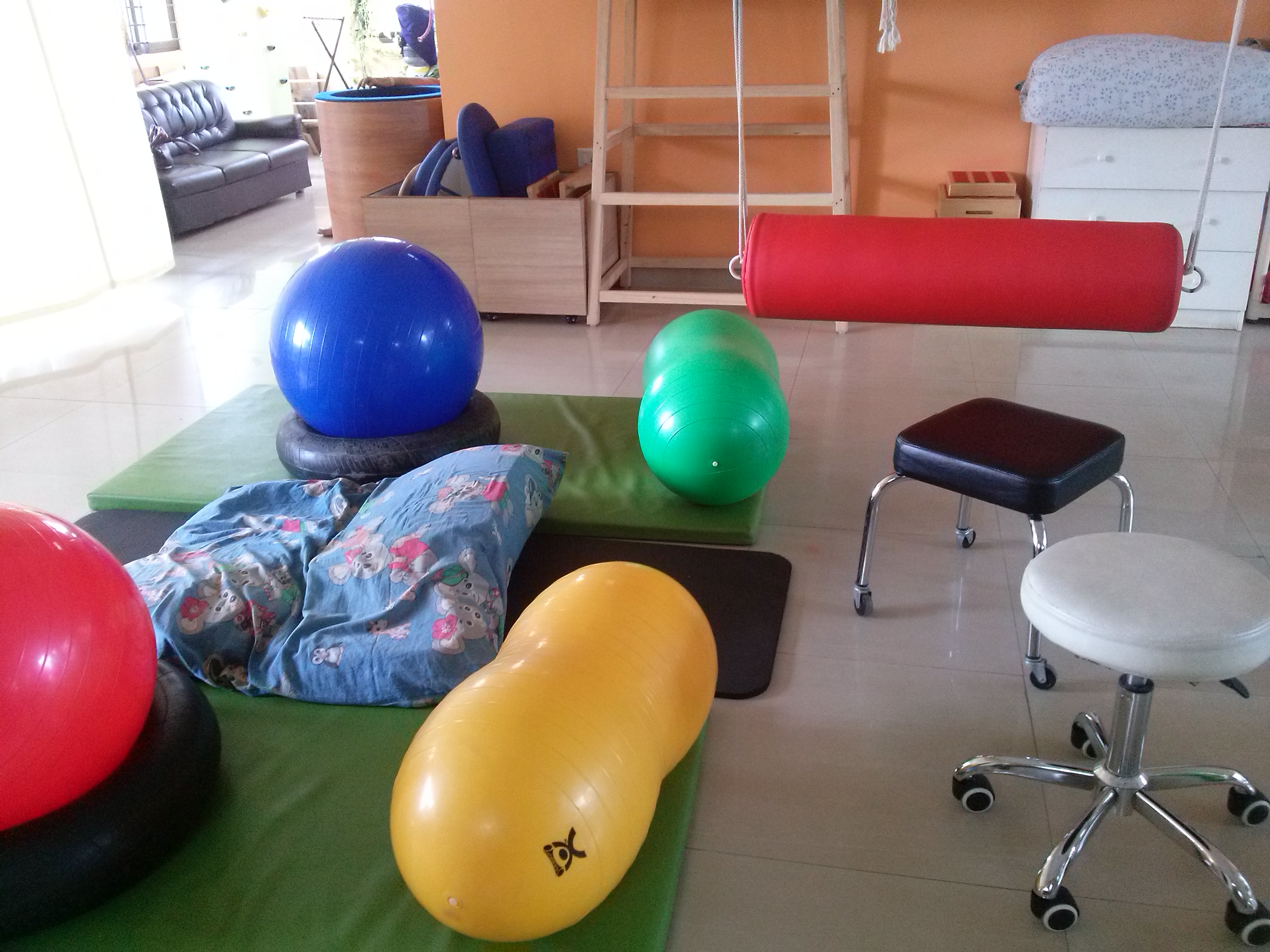
The Therapy Ball


The therapy ball is a common sight in every physiotherapy and occupational therapy department or clinic.  It has become ubiquitous in gyms and seen in homes as well.

Every physiotherapist whether working with children or adults will have some experience working with the therapy ball. As a pediatric therapist in Bangalore, more than 90% of my parents have proudly reported to me – we have a therapy ball.

What does the child do with it? They love bouncing on it.

What size is your ball? A very big size.

Why did you buy it? Our therapist asked us to buy the biggest size possible.

Such conversations have been common with most parents, and make me feel somewhat uncomfortable. My concern is safety. A young child being unsupervised and bouncing on a ball uncontrollably on hard floor makes me nervous. Young children with autism, ADHD, sensory processing dysfunction, and other diagnoses are highly likely to have lack of safety awareness.

My strong belief is that the therapy ball is ‘a tool’ in our therapy toolbox and not ‘the only tool’ in pediatrics. It is another medium to facilitate movement, alignment, and posture.

There is much more to ball beyond bouncing on it. The reality is that the therapy ball has many uses and benefits that therapists need to understand and possibly explain some information to the parents or our adult patients. We also need to keenly observe the relationship of the ball’s size to the changing posture and alignment in our clients.

Therapy ball can be used for many purposes --

·       making movement easier for our clients who have issues with muscle tone

·       challenge their balance

·       provide vestibular stimulation

·       provide movement to children who don’t experience movement frequently

·       facilitate weight-bearing on upper extremities

·       learning to roll the ball, bounce, and catch is sometimes easier with the therapy ball rather than a regular 8” ball

·       Entice and attract children

Therefore, just like any form of intervention in PT, therapists need to think about WHAT & WHY of using a ball. While on a ball in any position, is the child’s posture better, is the alignment of body segments altered, which muscle is being lengthened, which muscle group is working concentrically / eccentrically? 

Size of the ball highly matters and varies with your therapeutic purpose of using the ball.

In many instances, parents have informed me that their infant or toddler would cry throughout the session while on a therapy ball. Possibly the child is gravitationally insecure, or dislikes the prone position the ball, or feels unsafe while being seated on the ball. It is then prudent to work with the baby in mom’s lap or therapist lap. A toddler can be seated on a small stool / bench or positioned prone on a wedge / pillow. 


Prolonged sitting due to screen work seems like a necessity for IT professionals. Sitting for long hours leads to back and neck pain that can sometimes escalate to debilitating levels. One of the multiple modes to counter this is to sit on a therapy ball instead of a chair. Sitting on a therapy ball permits subtle bounces and movements, helps you to make postural adjustments, and compels you to stand up frequently. It becomes a way of preventing static sitting. The size of the ball needs to be chosen well so as to promote comfort and optimal alignment of the body.  To some of my back patients, I have suggested sitting on the therapy ball while working at a computer, after educating them about the size of the ball, posture, and how long at a time.  

 Pictur Credit : Activ Kaarya

Although the ball is used frequently in my clinic, it is only one tool amongst many others. The next time you bring out the ball, for a child or an adult, think about its primary purpose for your client. 

Monday, 27 December 2021

The Humble Staircase

It is a relief to witness the increasing awareness towards health and fitness in the current times. Courtesy to TV advertisements and social media, individuals are at least aware of healthy diet, lifestyle, and the importance of exercise. There is an effort to include movement and exercise via regular walking, Yoga, gym, and many more activities.

On the other hand, we miss out on small but frequent opportunities to exercise our body. In the frenzy of completing endless tasks in a day, we attempt to save time by taking the elevator, parking the car close to our destination, and ordering stuff rather than walking to pick up our food even if it is a nearby eatery. These are valuable short duration exercises that are so crucial for fitness, but ironically lost to us.

For the metropolitan dweller who lives in high-rise buildings, taking the stairs is something that needs to be consciously remembered. In my recent clinical experience, it was a surprise that some children were not used to stair-climbing on a routine basis.

There are many benefits of negotiating stairs—

· Improved leg strength, particularly the knee and hip extensor strength that are among the strongest muscle groups in the body.

· Increases balance.

· Reinforces alternate reciprocal movement patterns of the legs, similar to cycling, thus improving bilateral coordination.

· Enhances cardiopulmonary capacity.


On starting to negotiate 1-2 flights of stairs on a daily basis, I have observed clinical improvements in many children in terms of reduced clumsiness, increased balance, and reduced genu recurvatum (knees pushed back abnormally due to quadriceps weakness).

My advice to parents of young children is to climb 2 flights of stairs twice per day.

To adults, try to climb 2-3 floors before you take the elevator to your apartment on higher floors.

Having grown up in Mumbai during the 70s and 80s, I remember people climbing 4 flights of stairs well into their 50s and 60s. One may argue that they had no option since there were hardly elevators in 4- storey buildings constructed at the time. My perspective is different - they did not give up their daily habit of negotiating stairs. The same habit contributed to their health and fitness.

So why should we give up on climbing stairs at a much earlier age? Remember ‘use it or lose it’? Prior to Covid, it was heartening to hear from an adult that his office staff had decided to avoid using the elevator as much as possible for health and environmental benefits. While working in a New Jersey hospital 30 years ago, we would make it a habit to take stairs rather than an elevator.  


However, no exercise should be overdone. An example would be one of my patients who climbed 16 floors daily in an attempt to lose weight. Within 10 days he developed knee pain and required physiotherapy intervention. Negotiating 2-3 flights, in moderation, if you are not suffering from current injury should be fine. Always check with your doctor or a physiotherapist who is aware of your health conditions of the heart and the joints of your lower body.

So next time you see an elevator anywhere, take the stairs with your child for 1-2 floors. It is good for you, good for your child, and good for the environment. Take advantage of that small but crucial physical activity. Remember ‘use it or lose it’!

Thursday, 14 January 2021

Relearning to Cycle

It is believed that one does not forget certain skills such as swimming, driving, and cycling.  This did not apply to me when I decided to start riding a bicycle after a gap of almost 2 decades. Needless to say but important to remember that I am heavier, older, and less agile.  The fear of falling was so profound when I first mounted the new bicycle. On attempting to peddle, I froze with fear when the feet needed to be lifted off the ground. It was difficult to find my footing with the second pedal while one foot was on one of them.  Feeling very much scared, I yelled at my husband when he verbally instructed me in an attempt to help me. The experience reminded of gravitational insecurity that I observe in young children as a clinician.

I felt as if I had no balance since I was perched on a very narrow base of support that a bicycle offers. My eyes were glued to the handle. Steering the handle and balancing on the bike seemed like an unachievable task during the first few rides. I would hold my breath while balancing and consciously remind myself to breathe. It took many rides of practice just to take off, pedal, and keep my balance.

While looking at something far away while cycling, I felt a loss of balance that increased my heartrate. On a quiet street, cycling by a pedestrian or a parked car increased my anxiety (open environment). And making turns was a totally different challenge that took weeks to learn.

Coming up the slope made me realize how decreased were my strength and endurance although I do lead an active lifestyle.  I now cycle on a relatively busy street; but with low confidence, and very well understand that it will take much more practice and effort on my part.


So why am I sharing this experience of relearning a skill that I was pretty good at?

Relearning to cycle has been a great experience from an adult perspective, albeit filled with fear and anxiety. It confirms what children experience while balancing and engaging in challenging movement tasks during physical therapy sessions. My personal experience of cycling after many years can be extrapolated to special needs’ children learning to pedal.

Learning the skill of riding a tricycle, and later a bicycle with training wheels is a perennial issue seen in children with special needs.  Cycling requires the following components-

  •         ability to sit upright and balance
  •        pedal the wheels that needs good strength of the muscles of the leg and the lower trunk
  •         the alternate reciprocal movement of the legs requires bilateral coordination between the two legs.
  •         maintain the balance while the cycle moves forward (dynamic balance)
  •         steering the handle to make turns
  •         looking sideways or far away while riding

 All of these components are further challenged when the child graduates to a bicycle with training wheels because the base of support narrows drastically from a tricycle to a bicycle.

Many children receiving physical or occupational therapy, although having achieved the ability to walk, still present with abnormal muscle tone, deficits in balance and vision-perception, gravitational insecurity, and weakness. Most of them have learned to sit and walk at a much later age than typically expected. Therefore, it should follow that higher gross motor skills such as cycling and jumping are going to be delayed. 

Children with special needs should be provided more time and increased practice to learn cycling. Ample patience is warranted from parents and therapists alike.  It helps if learning to pedal is practiced on a stationary bike such as a peddler or a floor bike.

http://sensoryintegrationbangalore.blogspot.com/2016/03/peddler-in-pediatric-therapy.html

Most children at our center have learnt to cycle by practicing on a peddler during therapy sessions. The age range of these children has been 4 years and above, whereas developmentally a child may learn to ride a tricycle much earlier. The time taken to learn cycling has taken anywhere between 1  to 6 months of practice with the peddler. Motor learning of any skill requires repetitive practice of 100s of times.

It is a joy for the parent and a liberation for the child once cycling is learnt. The cycle provides physical exercise, movement, balance, bilateral coordination, and becomes a sensory motor activity. 


·      

Friday, 24 July 2020

W-sitting


W-sitting is an ATYPICAL way of sitting on the floor;  the buttocks rest on the floor while the lower legs point outwards and back.  Toddlers and preschool kids are often seen in w-sit position while playing with toys. For the child, it is a stable position and hence w-sitting becomes a habitual behavior quickly. 

If a child w-sits for prolonged periods of time, the consequences would possibly be any or all of the following:
Hip joint distortion—muscles and soft tissues on the medial aspect of the joint would be hyper flexible, whereas the same on the lateral aspect of the joint would be tight and contracted. 

Knee joint and feet distortion—the abnormal position of w-sitting would naturally place the knees and ankles in an abnormal position with similar consequences as the hips. 

Pigeon-toe gait---the distortions at the hips, knees, and ankles lead to in-toeing or pigeon-toe walking. This gait deviation does not only matter cosmetically, but leads to abnormal bone development of the lower leg.

Core muscle stability—remains  under developed  as a result of prolonged w-sitting position, since the muscles of the abdomen and back have to work minimally during w-sitting rather than being challenged. 

Crossing midline and Bilateral coordination—remain poor secondary to lack of trunk rotation that characterizes w-sitting. 


Conversely, if a child is frequently observed to w-sit, one or more of the following could be suspected:
Increased internal rotation of the hips.
Laxity of the hip joint ligaments.
Low muscle tone.

Children with neurological conditions such as cerebral palsy,  hypotonia, autism, and ADHD are highly likely to assume the w-sit position. They should be encouraged to sit in cross-legged or long-sitting positions during floor time.  Tall -kneeling is another position that can be encouraged during table-top activities. Otherwise they are at risk of learning higher functions that involve reaching, manipulation of objects, as well as writing.

Friday, 1 May 2020

Therapeutic Use of the Forgotten Board Games


Snakes & Ladders is an ancient game of India that probably provided a moral lesson of life’s ups and downs as per virtues (ladders) and vices (snakes) respectively. There is a simple colorful grid of numbers 1-100, with a contrast of snakes (live being) versus ladders (inanimate gadget) drawn on it in a particular fashion and in different sizes. Its Western counterpart is Chutes & Ladders.

Growing up in 1970s India, abundant time was spent on playing three common board games, the Snakes & Ladders, the Ludo, and the Business. These games helped us to practice math learned in school and taught emotional regulation when your own token piece was not moving forward or had to come to a lower value number on the board.


As therapists or any professional working with children, we are aware of how challenging it is for a child with special needs to translate therapy and classroom gains to the external environment.
Therefore, I made a concerted effort to introduce the Snakes & Ladders to children in my clinic who were about 5-7 years of age. These are children who loved to work with any activity that included numbers. Over time, when their readiness to participate and engage with another child improved, and they had mostly overcome their rigidity or obsession with numbers, they were ready for their first board game of Snakes & Ladders.

Despite children being good at numbers 1-100, it came as a surprise to moms that the game was not as easy for their child. We came across the following challenges –

Taking Turns
For most young children, waiting for their turn is always a work in progress with any new activity.

Using Hands for Tiny Objects (dice)
The concept of rolling and throwing the dice had to be taught using cupped hands joined together.

Visual Recall and Working Memory
Remembering your own token piece and its position on the grid during their last turn needed verbal cues from an adult. Visually counting the number of dots on the dice and moving the same number of squares on the board required significant help.

Visual Sequencing and Directionality
Continuing from their last position was again a different concept for the child, i.e. sequencing from the number that they were on their last turn.


Sense of directionality while moving the token piece in increasing order of numbers was another difficulty. Their instant reaction was to move the token piece in any direction – backwards, forwards, or upwards. Although the child is good at numbers in terms of recognition and sequencing verbally, following the correct direction on the board becomes a challenge.

Moving from left to right in one row versus right to left in the immediate next row was difficult to comprehend.

The concept of going up the ladder or coming down the snake had to be reiterated multiple times. Some children initially had an emotional issue while coming down on the snake, hence this rule needed to be ignored for the time being.

Task completion
Patience to complete the game required sustained attention, and going up or down helped work towards building emotional control.

Take Away
In summary, Snakes & Ladders is a simple game that can be introduced in sensory motor therapy and can be continued with the child at home. It offers significant therapeutic value to children with special needs to boost working memory, vision-perceptual skills, and generalization ability.

The same goes for Ludo or Pachisi or Parcheesi which can be introduced after reasonable comfort with Snakes and ladders. The Business is another board game if parents wish to teach counting and exchanging money to a child.

These simple board games may look unappealing in this fast-paced, digital world. Once we understand their impact on family bonding and applications to the real world, they become indispensable.